A Historical Perspective on the Biogeography of the Pampa Region: Imprints of Time and Origins of Its Flora

Abstract
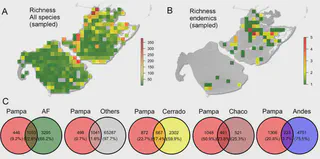
The Pampa, also known as Río de la Plata grassland region, is arguably one of the most diverse and largest grassland areas in the world, yet timing, origin, and assembling of its flora are not well understood. Here, we provide a first comprehensive overview of the angiosperm historical biogeography in the Pampa and neighboring regions, by integrating a comprehensive phylogeny with 70,040 species, occurrence datasets, and models of geographical range evolution. The richness distribution of species sampled in our analyses is highly congruent with reports from the literature, where the Campos subregion in the North has higher levels of absolute species number and endemism. Also, our results corroborate long-standing views from phytogeography, such as a great number of lineages shared among the Pampa, Atlantic Forest, Cerrado, Chaco, and Andes, and a great exchange of lineages among these regions. Our results suggest that the Pampa is a macroevolutionary sink of angiosperm diversity, where a strong asymmetry of lineage exchange from other areas to the Pampa was detected. Our results are also in agreement with evidence from the fossil record, placing both lineage exchange (dispersals) and sympatric events (diversification) related to the Pampa very recently in geological time, with estimates concentrated in the Pliocene onward (with a great increase during the Pleistocene). Altogether, our results demonstrated the complex origin and dynamism of the Pampa flora and the importance of dispersal events for its assembly. Finally, putative caveats and future directions to further uncover the origins of the Pampa flora are discussed.
Type
Publication
South Brazilian Grasslands: Ecology and Conservation of the Campos Sulinos

Comments