Uruguay's Online Flora: A new resource connecting science, society, and conservation
Jan 1, 2026·,,,,,,,,,,,,,,,,,,,,,,,,,,,,,,,,,,,,,,,,,,,,,,,,,,,,,,,,,,,,,, ,,,,,,,,,,,,,,,,,,,,,,,,,,,,,,,,,,,,,,,,,,,,·
0 min read
,,,,,,,,,,,,,,,,,,,,,,,,,,,,,,,,,,,,,,,,,,,,·
0 min read
J. Mauricio Bonifacino
Ary Mailhos
Eduardo Marchesi
Andrés Rossado
Federico Haretche
Andrés González Rosales
Carlos Brussa
Patricia Mai Morente
Gabriela Speroni
Victoria Valtierra
Carolina Toranza
Pedro Pañella
Felipe Lezama
Mariana Cosse
Florencia Grattarola
Marcela Preliasco
Pablo Berazategui
Rosario Beyhaut
María Zabaleta
Felipe Cairello
Gustavo Heiden
João Iganci
Kenneth J. Wurdack
With Contributions By
Serrana Ambite
Bianca O. Andrade
Milagros Anzuinelli
Angélica Arcila-Lopera
Pablo Armand Ugon
Adriana Bartoli
Daniel Bayce Muñoz
Manuel Belgrano
Ángeles Beri
Andrés Berruti
Paul Berry
Pablo R. Boggiano
Ilsi Boldrini
Sergio Bordignon
Patricia Brussa
Vinícius R. Bueno
Henrique Mallmann Büneker
Débora Cintia Chamorro
Jorge v. Crisci
Philip Davies
Osvaldo Del Puerto
Marina Díaz
Sabina Donadío
Cleusa Ely
Cecilia Ezcurra
César Fagúndez-Pachón
Renée Fortunato
Federico Gadea
Paola Gaiero
Renato Goldenberg
Silvia E. González
Ivan A. Grela
Julián Alejandro Greppi
Martin Grings
Pablo Hernández Olveyra
Colin Hoag
Martín Jaurena
Gabriela Jolochin
Liliana Katinas
Matias Köhler
Leslie Landrum
Dióber B. Lucas
Sandra Lupo
Jennifer R. Mandel
Gastón Martínez
Ana L. Mello
Nidia Mendoza-Díaz
Detlev Metzing
Fabrício Schmitz Meyer
Fabián A. Michelangeli
Marcelo Monge
Robbin Moran
Fabián Muñoz
Felipe Noli
Nataly O'Leary
Mario Oloriz
Eugenia Pedrero
Camilo Pérez
Silvina Piastri
Antonella Pollero Martínez
Mónica Ponce
Jefferson Prado
Clara Pritsch
María Puppo
Marianella Quezada
Mercedes Rivas
Carmen Rossini
Gisela Sancho
Anderson Santos De Mello
Darío Schiavinato
Mercedes Souza-Pérez
Pablo R. Speranza
Guillermo Suárez
Ana Tardáguila
Cristina Trujillo
Estrella Urtubey
Magdalena Vaio
Meica Valdivia
Rafael Vidal
Jessica Viera Barreto
Cassiano A.D. Welker
Henrique Zamengo
Fernando O. Zuloaga
Uy-BOL
Abstract
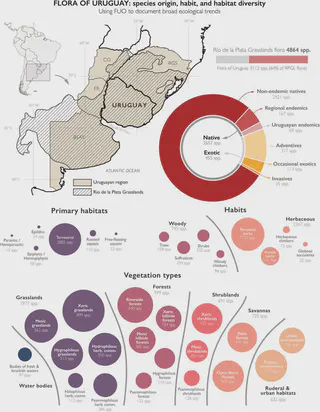
Floras and botanical collections are essential tools for understanding plant diversity, promoting its conservation, and supporting a wide range of scientific applications. Uruguay, located in the biodiverse grassland region of southern South America, has had only an incomplete Flora, the most comprehensive of which was published more than a century ago. We review the country’s flora and the history of its study, and introduce the new Flora Uruguaya Online (FUO; https://florauruguaya.org), which when completed will provide a comprehensive record of all vascular plant species, including information on their distribution, morphological, ecological, and phenological characteristics. This online Flora presently contains information on 182 families, 1053 genera, and 3112 species, 85.4% of which are native to Uruguay and 2.2% endemic. Although Uruguay accounts for only 25% of the surface area of the Río de la Plata Grasslands, it contains over 60% of their species and more than 50% of their endemic taxa, reflecting its core geographical position. Uruguay’s flora faces increasing pressure from land-use change, habitat fragmentation, and invasive species. FUO provides critical support for addressing these challenges, offering systematic botanical data for basic and applied research, conservation, sustainable uses, and land management, including practical applications such as the identification of toxic plants affecting livestock production. We highlight key features of FUO with its research-enabling tools for the exploration of Uruguay’s botanical richness by scientists, as well as by policymakers, educators, conservationists, and citizens. These features include its accessibility, interactivity, multiple filters (e.g., geographic regions, ecological characteristics, conservation status, or specific species attributes), rich graphics, and multiple sources of data inputs tied to herbarium specimens.
Type
Publication
TAXON

Comments